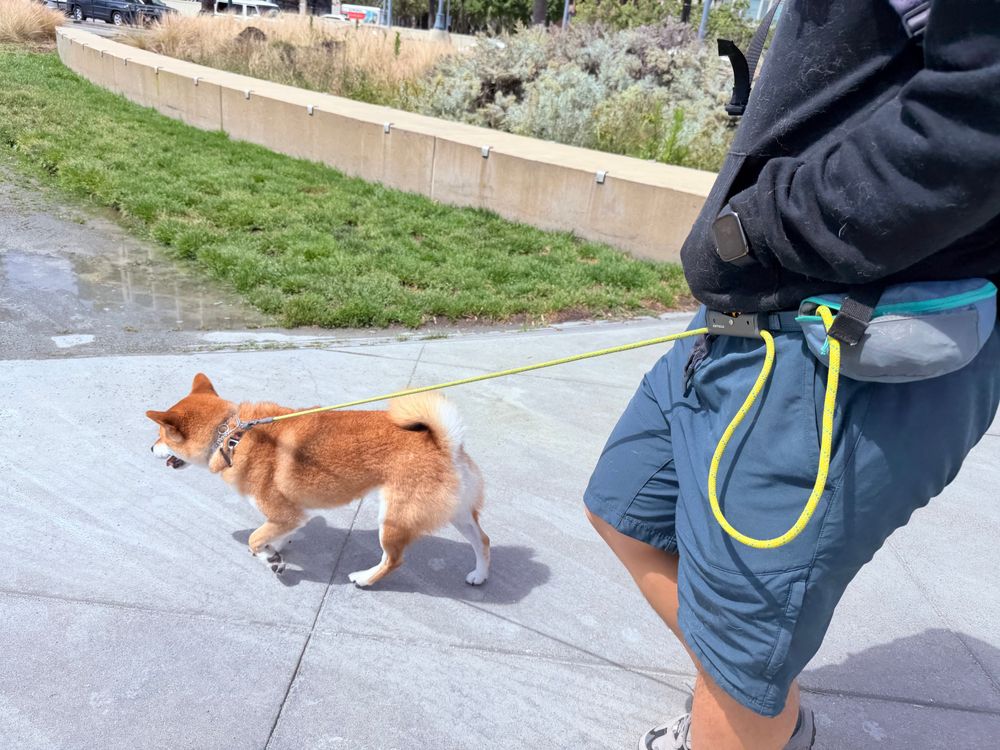
If your dog hits the end of the leash and you feel your arm shoot forward, that's not just uncomfortable—it's information. Your arm just taught your dog that pulling works. A hands-free leash removes that lesson entirely, and that's the argument for it that most articles miss.
Yes—and they work precisely because of the physics involved. A handheld leash has a moving anchor: your shoulder, elbow, and wrist all flex the moment tension hits. Every lunge gets a little give, which your dog reads as progress. A waist clip is a fixed point. When your dog hits that line, there's no extension, no give, no reward. The boundary is the same every single time.
Think of it like a boat tied to a post versus a boat tied to someone's hand. The post doesn't move. The hand does. Your dog isn't testing your strength when it pulls—it's testing the consistency of the anchor.
Anchoring at the hips uses your body's strongest center of balance. A large dog pulling forward against a grip-strength hold can rotate your shoulder and drag you off-balance. That same dog pulling against your hips has to move your entire lower body, which is considerably harder.
This is why a hands-free dog leash isn't just a runner's accessory. For everyday walkers dealing with a puller, a fixed waist anchor enforces a consistent leash length without you having to consciously hold it. Your dog gets cleaner feedback. You get fewer shoulder workouts you didn't ask for.
The leading cause of leash-on dog escapes isn't a broken clasp—it's a dropped leash. A distraction, a trip, a door-hold, a dog that bolts faster than your grip can track. A waist clip is a fail-safe against all of it. Your hands being empty doesn't create the risk; it removes one.
In crowded or high-risk areas, there's a secondary benefit: because the leash is physically attached to your torso, it's significantly harder for a third party to grab or unclip your dog than if the handle is dangling from your hand.
If your dog is still learning leash manners, skip the bungee-section hands-free leashes. The stretch is useful for running, but for a dog that's still figuring out where the end of the line is, it reintroduces a moving anchor. A fixed-length nylon or biothane waist leash gives cleaner feedback during training.
Once your dog understands leash pressure, the bungee becomes a non-issue. But during the learning phase, you want the post, not the hand.