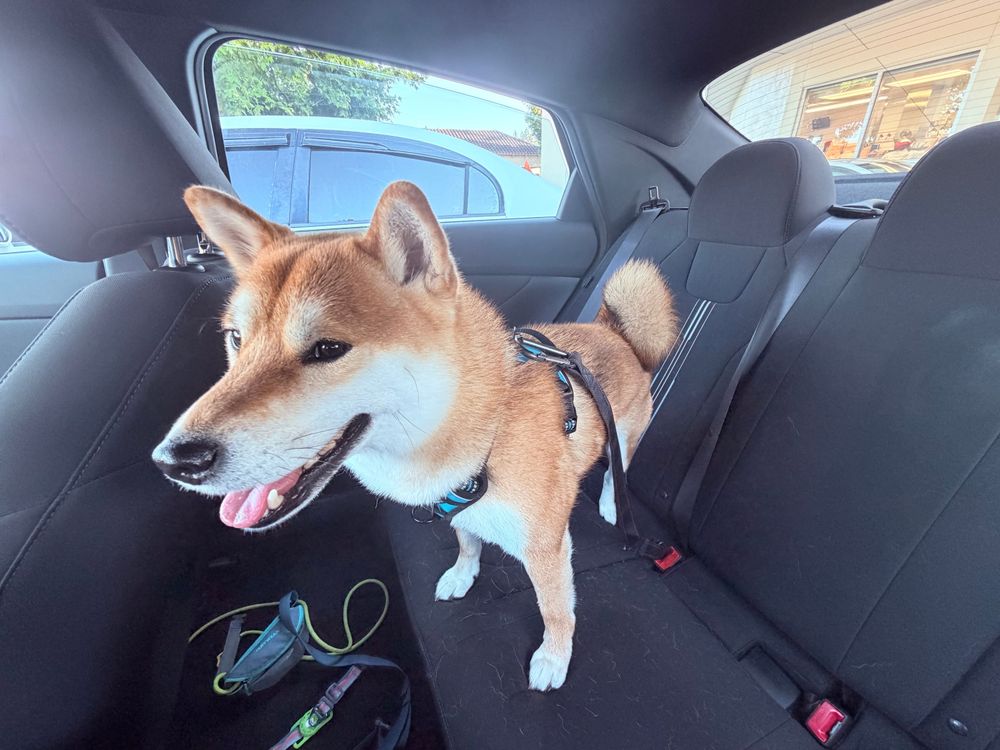
A dog seatbelt is only as safe as the attachment point. Clip it to the wrong ring—or the wrong piece of equipment entirely—and a 30 mph stop turns the belt into the hazard. Here's how to set it up right.
In a sudden stop, a collar concentrates every pound of force on your dog's neck. At car speeds, that's enough to collapse a trachea or fracture a vertebra. If your dog currently rides clipped to their collar, that's the first thing to fix—before anything else.
One equipment note before you clip anything: most standard walking harnesses aren't crash-tested. The plastic buckles that hold up fine on a trail aren't engineered for a 30 mph collision—think of it like the difference between a bike helmet and a motorcycle helmet. They look similar, but they're built for completely different forces. If you're shopping specifically for car travel, look for a harness with independently published crash-test results; brands like Kurgo and Sleepypod both make them.
Most harnesses have two rings: one at the chest and one centered between the shoulder blades. The chest ring is the front clip. The back ring—between the shoulder blades—is the one to use in the car.
Front-clip harnesses are excellent for leash training, where the side-pull mechanics help redirect a dog that pulls. In a car, a front-clip attachment creates what's sometimes called the spin effect. In a hard brake or side impact, a dog clipped at the chest rotates as the force transfers unevenly through the harness. That rotation puts severe torque on the shoulders and hips and can cause dislocations that a straight-line stop would never produce. The back clip keeps the load centered, letting the harness's chest plate absorb the impact across the ribcage—the strongest load-bearing structure on a dog's body.
For car travel, tighter than you'd set it for a walk. Use the two-finger rule: you should be able to slide two fingers—and only two—between the strap and your dog's skin. A walking-loose fit allows a dog to launch through the harness on impact, even when the tether holds.
Adjust the tether length so your dog can sit or lie down comfortably but can't reach the back of the front seats or drop to the floorboard. Slack is its own hazard.
Even in a harness, even clipped correctly to the back ring, a dog should never ride in the front passenger seat. Airbags deploy at forces designed for a braced adult—not a dog. For a restrained dog at close range, the impact can be fatal. Back seat, every time.